


The UK is one of the world’s most popular study destinations, drawing students from around the globe. For many international students, a degree here is also a chance to build career experience through internships, part-time jobs, or placements that turn classroom learning into real-world skills.
That experience can pay off long after graduation. When graduate hiring is competitive, the students who stand out are often the ones who’ve already worked and built a network. This guide covers the work you can do while you study, the internships and placements many courses offer, and how to keep building your career readiness after you graduate.
UK Student Visa Holders’ Work Guidelines
Most international students come to the UK on a Student visa. It lets you work, though the hours depend on your course level and whether classes are in session. Your institution also needs to be a licensed student sponsor before you can take a job. Sponsors may be higher education institutions (HEIs), public colleges, independent schools, or private providers. For example, if you enrol at Cardiff Metropolitan University in Wales, they’re also your sponsor and will share specific information about how long you can work, where, and when.
How Many Hours You Can Work
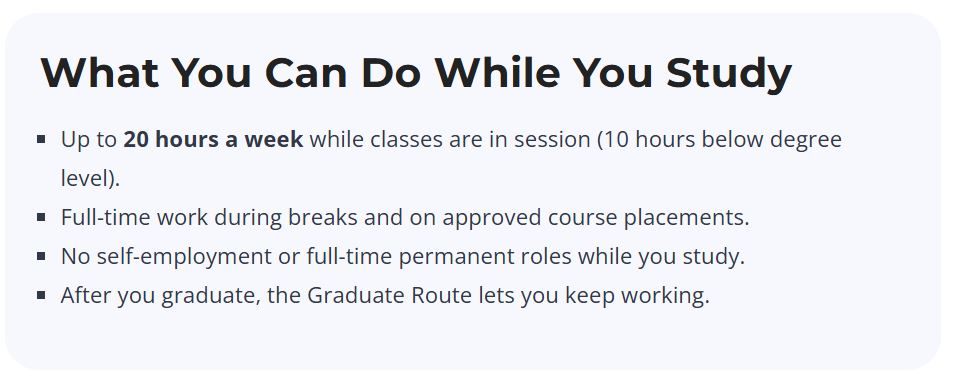
While classes are in session, a degree-level course (Regulated Qualifications Framework, or RQF, level 6 and above) lets you work up to 20 hours a week. On a course below degree level (RQF levels 3 to 5), the limit is 10 hours a week. Once classes finish for the year, such as over the summer break, you can usually work full-time, as you can on an approved placement that’s part of your course.
What Your Visa Doesn’t Allow
Your Student visa also sets a few rules about the kind of work you can do. It doesn’t let you be self-employed, run a business, take a full-time permanent job, or work as a professional sportsperson, coach, or entertainer. The conditions printed on your visa are the final word, so read them closely.
Gaining Work Experience Before You Graduate
 |
Some of the most valuable experience is built right into your studies. Internships and placements let you apply what you’re learning, try out a career, and grow your network before you graduate. In a competitive job market, that head start can be what sets you apart. |
Internships
An internship is one of the best ways to see what a job is really like. Most run over the summer, and they can last anywhere from a week to a full year.
Whether an internship is paid depends on its type. An extracurricular internship, one that isn’t required for your course, should pay at least the National Minimum Wage. If the internship is a required part of your course and runs under a year, it may be unpaid and give you academic credit instead.
Sandwich Courses and Placements
| A sandwich course blends study with a longer work placement, usually in industry. On a “thick” sandwich, you spend a full year on placement, often in your third year, so your course runs four years in total. A “thin” sandwich splits shorter placements across your degree, so you can still finish in three years. Either way, a placement year often makes it easier to find a job afterward, because you graduate with real experience on your CV. |  |
Building Your Future With the Graduate Route
When you finish your degree, the UK’s post-study work route, the Graduate Route (also called the Graduate visa), lets you stay in the UK to work or look for work. For many international graduates, it’s the bridge from studying to a first job.
Who Can Apply
You can apply for the Graduate visa if you’re in the UK on a Student visa when you apply. You’ll also need to have completed an eligible course, such as a bachelor’s degree or higher, at a provider that confirms to the UK Home Office that you’ve finished.
How Long You Can Stay
Your Graduate visa length depends on your qualification and when you apply:
- 🔹Bachelor’s or master’s graduates: two years if you applied by 31 December 2026, otherwise 18 months.
- 🔹PhD or other doctoral graduates: three years, whenever you apply.
What You Can Do on a Graduate Visa
The Graduate visa gives you room to explore your options, letting you work in almost any job and at any skill level, be self-employed, change employers as you look for the right role, take on voluntary work, and travel in and out of the UK. The Graduate visa can’t be extended, so to stay in the UK longer, you’ll usually need to move onto another visa, such as the Skilled Worker visa, before your current one ends.
Another Option: The Health and Care Worker Visa
| If you’re qualified in medicine, health, or adult social care, the Health and Care Worker visa may be a better fit. It’s designed for trained professionals coming to work for the National Health Service (NHS), the wider health sector, or in adult social care. |  |
 |
We hope this information on studying and working in the UK is helpful as you plan your journey. |
Source: ApplyBoard